Sunday, January 07, 2007

5 Things About Me

Tim van Gelder tagged me in a blog-based game / pyramid scheme combining tag, and truth-or-dare. The rules say that once tagged you have to reveal five things about yourself that are not commonly known, and then tag five more people.

Five things that you probably did not know about me:
  1. My brain: Although right-handed, I am not left-brain-hemisphere dominant, but either right-brain-hemisphere or mixed-dominant. I believe that this is the case because I grip a pen like many left-handers, with the pad of my thumb resting on the side of the second joint of my index finger, with a somewhat flexed wrist.
  2. Taboo: I have kissed another man on the lips (on stage, while acting in an improvisational theatre format called Micetro).
  3. Self-treatment: After falling prey to a very rare medical condition, and doing the rounds of specialists to no avail, I used my non-medical scientific training to scan the literature (using via PubMed) and found a mild and effective medicine.
  4. Genetics: Despite neither me nor my partner nor any of our parents or grand-parents having red hair, both of our children are red-heads.
  5. Unheralded author: I have co-written a hilarious -- yet unpublished -- children's book. (Still waiting on our illustrator.)
I tag:
  1. Nigel Thorne
  2. Steve Hayes
  3. Lliam Amor
  4. Kevin Yank
  5. Peter Sbarski
Having once been tagged I now claim future immunity or "barley".

Wednesday, December 13, 2006

New Course on Super-Efficient Learning

During January 2007 I will be teaching a new course:

Super-Efficient Learning and Application

A four-session course introducing the concept of Super-Efficent Learning, with applications to martial arts practice.

Instructor: Sensei Dan Prager

When: Mondays 8, 15, 22, 29 January 2007, 8 pm
Where: Australian Federation of Instructors Honbu


Order of Presentation

Session One:
Break-falls and Beyond
Session Two: Don't Chance Your Stance
Session Three: Bring Your Throws to Life
Session Four: Portable Principles


This course will be of particular interest to students who are competent in their basic techniques, and are looking for tools to help progress from martial skills to Martial Art.

Wednesday, November 08, 2006

Super-Efficient Learning: Part II

As discussed in Part I super-efficient learning is all about training in exercises that have multiple benefits, i.e. killing two -- or more -- birds with one stone.

The foundational exercises of many traditional martial arts are -- as I will demonstrate -- super-efficient, even if they have not been described in that way previously. (The term "super-efficient" is my own invention, so remember: you read it first here.)

Jigoro Kano, the founder of Judo, selected his techniques from various Jiu-Jitsu schools that lived up to his dictum of "minimum effort, maximum effect". That's about efficiency at the level of the individual technique, so super-efficient learning can be thought of as extending the same principle into the realm of learning strategy. To summarise: "Learn the most efficient techniques, using the most efficient methods."

In this article I will describe the core break-falling exercises of Judo and Jiu-Jitsu, and discuss some of the many benefits of these outstanding exercises.

Throwing and Break-Falling in Judo and Jiu-Jitsu
Here is a very quick 30 second video showing several Judo throws.
In any martial art training that features regular training of throwing techniques, the participants will need to be able to fall confidently, reliably and -- above all -- safely. Safe throwing and falling is best achieved:
  1. Under the supervision and tutelage of an experienced instructor
  2. In a controlled environment where participants do not perform unpredictably, or beyond their level of competence
  3. Using appropriate equipment, such as a padded mat, which enables repetitive and comfortable practice.
In the method of teaching that I follow, which goes back to Minosuke Kawaishi, we skip conventional calisthenic warm-ups such as push-ups and sit-ups, in favour of a superior super-efficient option: Break-falling.
In our system, almost every class warms up with the standard break-falling exercises, and cools down with a fairly standard sequence of rolls. In this way, both warm ups and cool downs provide an opportunity to practice falling (and more falling), so that over time everyone's falling techniques become second-nature.
The Break-falling Exercises
The core set of break-falling exercises consists of two sets of 3 exercises performed on the back, plus 3 distinct exercises performed from a squatting position, repeated from a standing position.
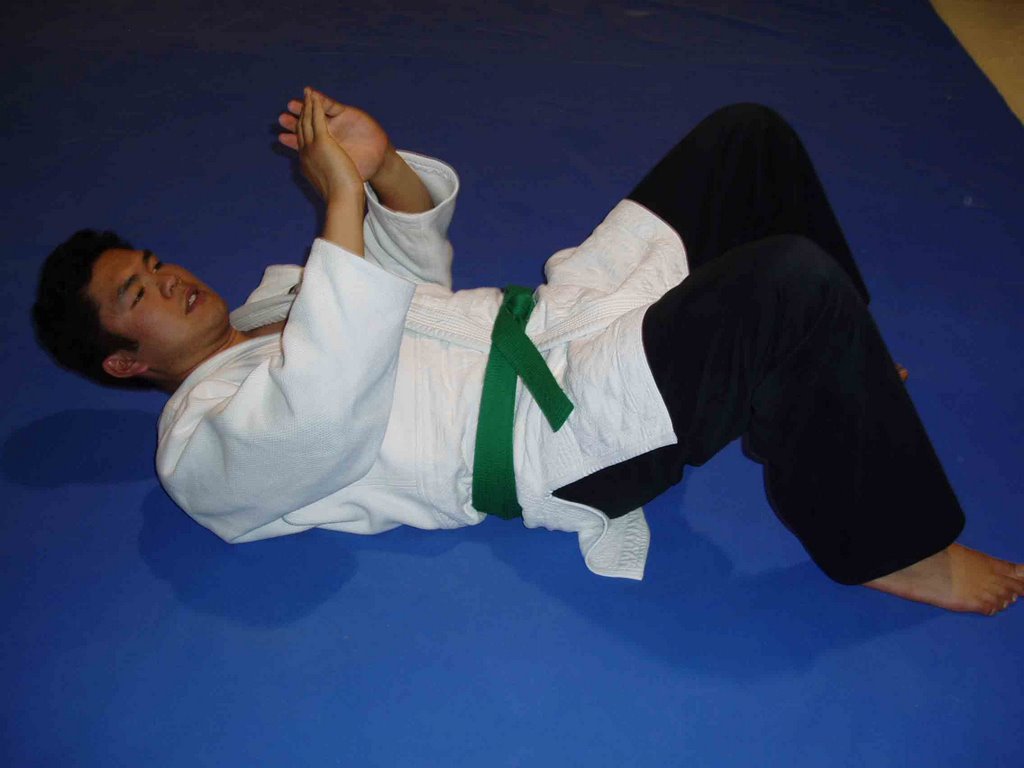
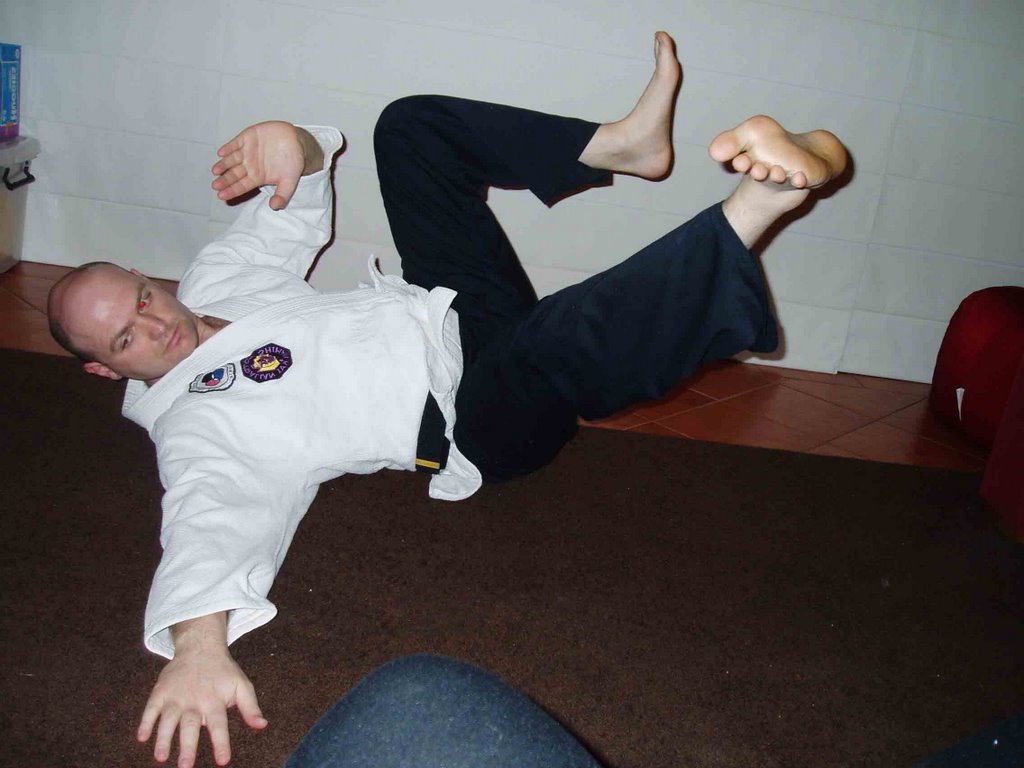
The 1st exercise commences lying on your back with knees bent; head raised off the mat; hands crossed at the wrists above your chest. You slap the mat with your palms and forearms striking the mat (hard!), and then return the starting position. This is usually repeated about 40 times, with -- ideally -- the entire class synchronised. The two variations add alternating left- and right- kicks, and double kicks.

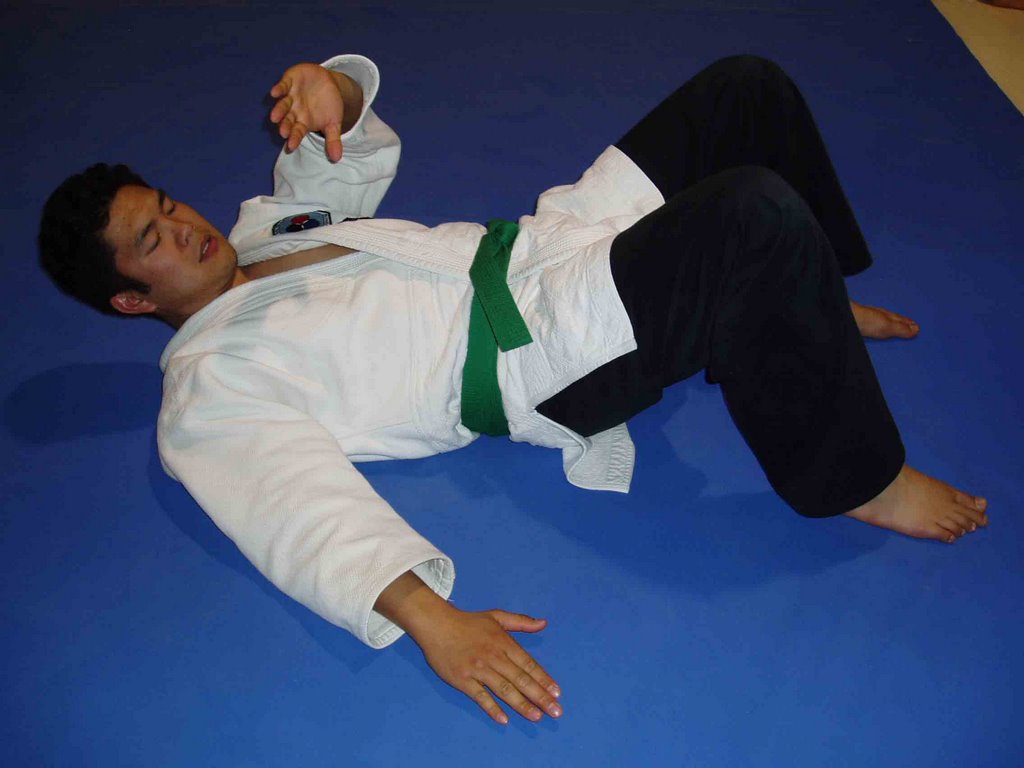
The second set of exercises consists of asymmetric variations on the first set, in which one hand slaps the mat while the other hand protects the face.


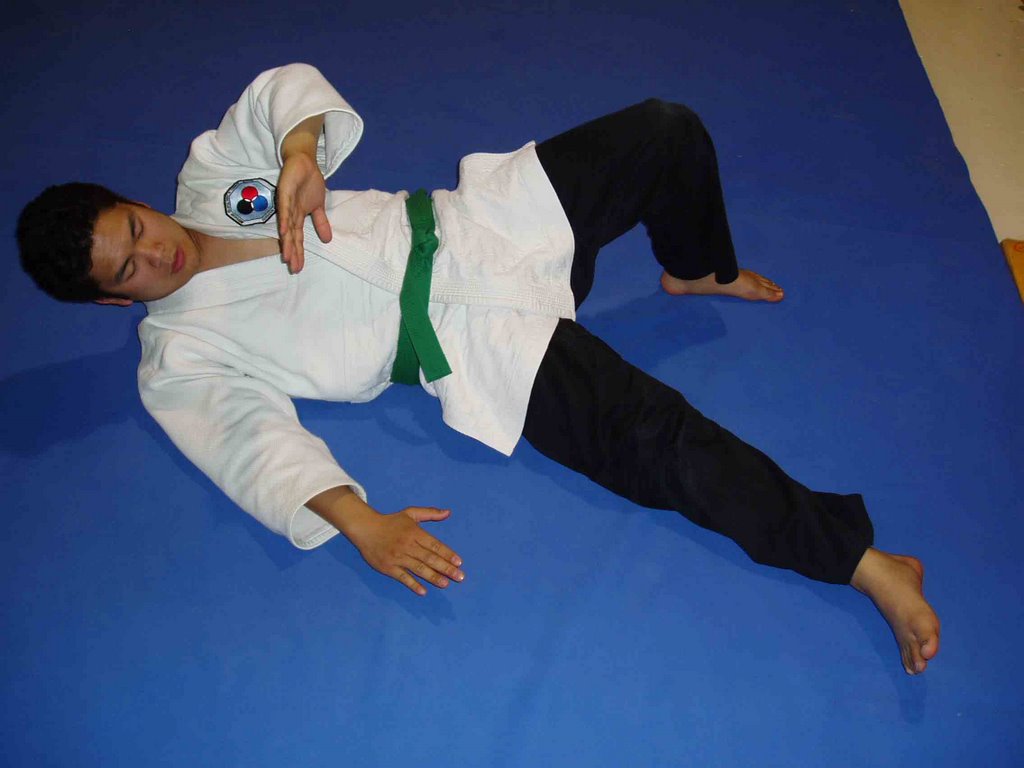
In the subsequent variations leg, hip, and body-movements are coordinated with the slaps. Here is the first variation:


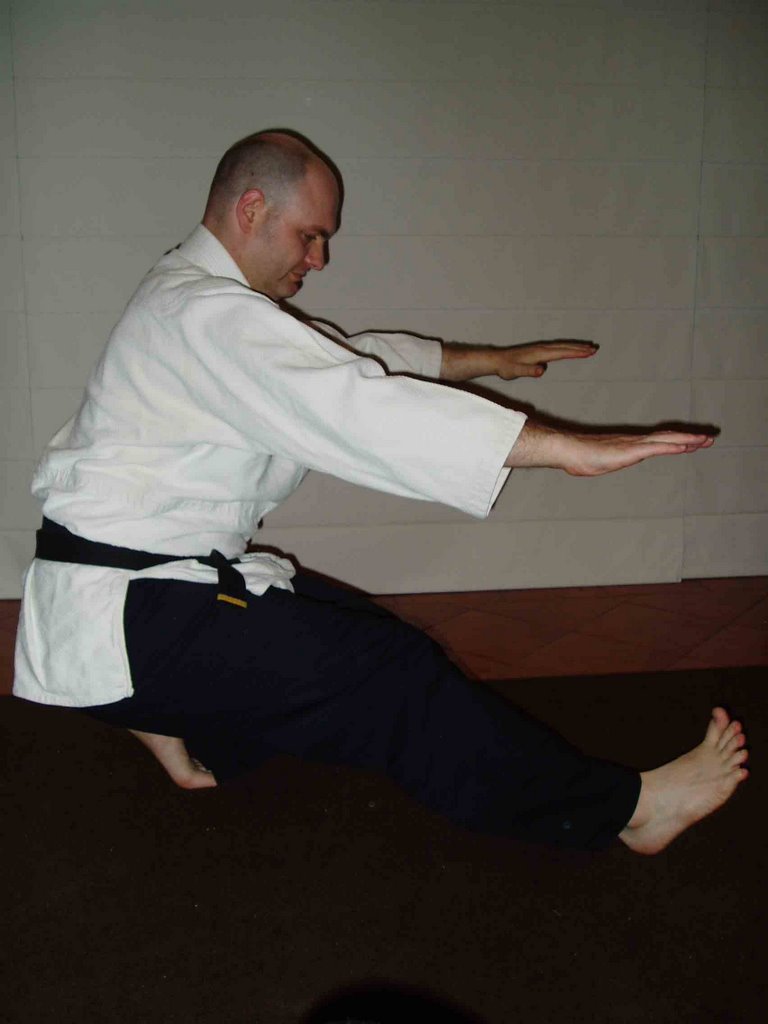
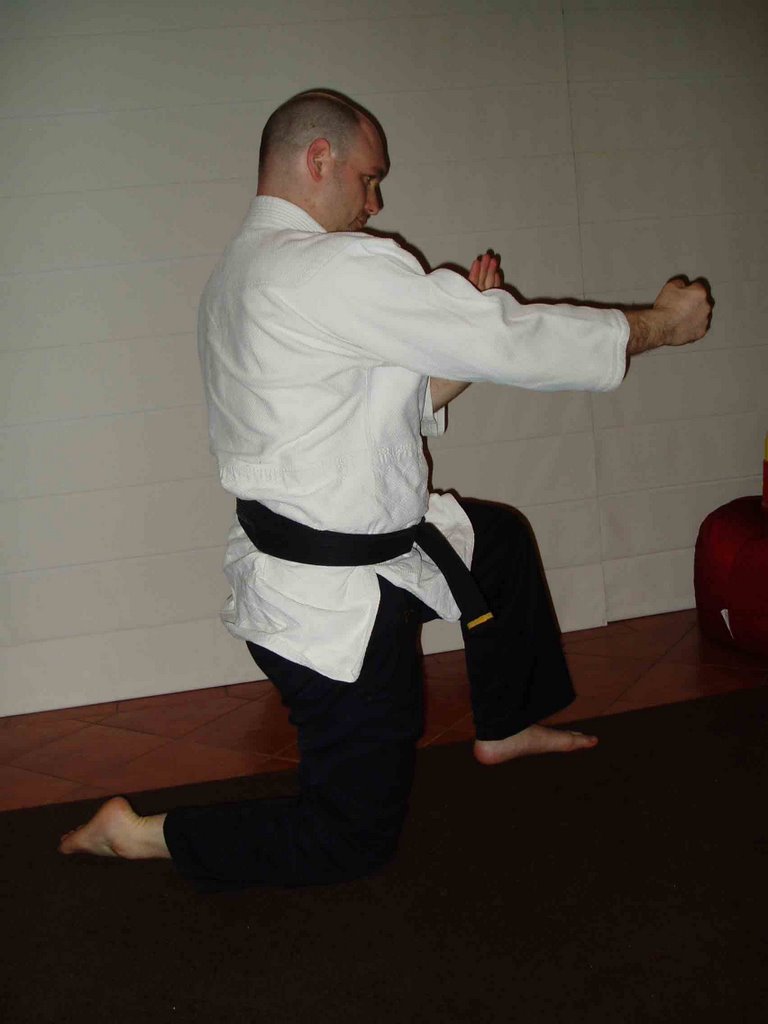
The following exercises further develop falling to the ground and getting up safely, with and without break-falls, starting from squatting (example below) and standing (not shown).


As usual for this blog, the preceding descriptions and photos are intended to convey the flavour of this system of instruction, but not the detail. Please do not try to learn break-falling without qualified hands-on instruction.

Benefits of Break-Falling
Now, to qualify as super-efficient, the benefits of these exercises must be multiple. What are they? Without further ado, here is my off-the-top-of-my-head list, broken down into a few categories.

Preparation for the rest of the class
  • Warming up the entire body
  • Gentle stretching
  • Starting to follow the instructor and participate as part of the training group
Foundational Skills of Judo and Jiu-Jitsu
  • Learning techniques of safe falling
  • Learning how to get up smoothly from the ground
  • Developing the conditioning to be able to survive the impact of striking techniques, and falls on hard terrain
  • Learning to protect the face in combat
  • Basic distancing
  • Basic kicking and punching
More Advanced Aspects of Judo and Jiu-Jitsu
  • Practicing important movements for ground-fighting
  • Preparation for “sacrifice throws”
  • Developing whole-body movement
  • Developing “soft” strength
General Physical Benefits
  • Strengthening the whole body; especially the neck, triceps, abdominal “core” and legs
  • Improving overall coordination
  • Improving posture and balance
  • Improving body awareness and sensitivity
  • Improving bi-lateral symmetry of musculature and movement
General Health Benefits
  • Learning to blend effort with relaxation
  • Practicing basic meditation
  • Practicing the coordination of breathing with effort
  • Improving auditory awareness and rhythm
  • Developing the ability to rapidly recover from sustained and significant effort
Note: I am happy to clarify the individual points in response to posted comments.

The Challenge: Exploring Super-Efficient Learning

  1. For martial artists who practice break-falling: "What's your perspective? Does the list help? Can you find other benefits?"
  2. For non-break-falling martial artists: "Can you find the super-efficient exercises in your martial art?"
  3. For everyone: "Can you find a good example of super-efficiency outside of the martial arts?"
Further instalments
In Super-Efficient Learning: Part III, I intend -- plan is too strong a word -- to look into super-efficiency in the Chinese Martial Arts, Yoga, and possibly Software Development!

Wednesday, September 20, 2006

Super-Efficient Learning: Part I

Efficiency, in general terms is usually taken to mean using the minimum of effort to achieve the desired effect. In quantitative terms: 100% efficient means without any waste.

So what is efficient learning? Is it picking up a new concept without wasting any time making mistakes? Perhaps, but there’s truth in the old saying that you learn more from your mistakes. How can that be reconciled with the notion of efficiency?

To better define efficiency in learning let’s take a step back and consider what the desired effect is in learning. Presumably it is to acquire or refine a skill, attribute, ability, or understanding.

To oversimplify: In conventional teaching I might set out to teach a new skill – say teaching young children to tie their shoelaces – and ¾ of my class might “get it”, giving my teaching of that skill an efficiency of 75%. No matter how brilliant my teaching is, the best that I can aspire to is 100% efficiency, and mostly I’ll fall a bit short.

Super-Efficency Defined
But what if instead of teaching an exercise with one benefit, I was able to find a set with multiple definable benefits? In simple numerical terms we could say that the efficiency can now exceed 100%. This type of teaching and learning could be justifiably termed super-efficient. The more benefits that are encoded in the exercise the better!

Do super-efficient exercises exist? You bet. The foundational training of several martial arts consist of super-efficient exercises, and I suspect that they may be found in other disciplines too.

In this day and age I believe we need to recognise super-efficient exercises as a time-effective way to develop and maintain high levels of health and skill. The more benefits an exercise has, the greater its:

  • repeat value
  • suitability for use with a non-homogenous training group
  • potential for training with different emphases
Super-Efficient Learning is not the same as ...
Perfect performance: Super-efficient exercises have many aspects to master, so they are more about learning and developing lots of things over time, rather than perfect execution and the absence of mistakes along way.

Multi-tasking
: Juggling while riding a unicycle and singing opera is impressive, but it is about doing lots of things at once, rather than using one thing to develop many capabilities.

Moving with awareness can transform any exercise -- from running to cleaning the dishes -- into a form of meditation. While undoubtedly a valuable mind-body practice, but moving with awareness is about making the most of any exercise, while super-efficiency involves making a particularly smart choice of exercise. The two practices are complementary.

Conclusion
Super-efficient learning is all about using learning exercises that develop many purposes at once. They are highly beneficial, flexible, and time-efficient.

In Super-Efficient Exercise: Part II I show how the break-falling exercises of Judo & Jiu-Jitsu constitute a wonderful (and super-efficient) set of exercises.

Thursday, September 07, 2006

Jiu-Jitsu in Pictures: Your Questions Answered

Q: What is it?
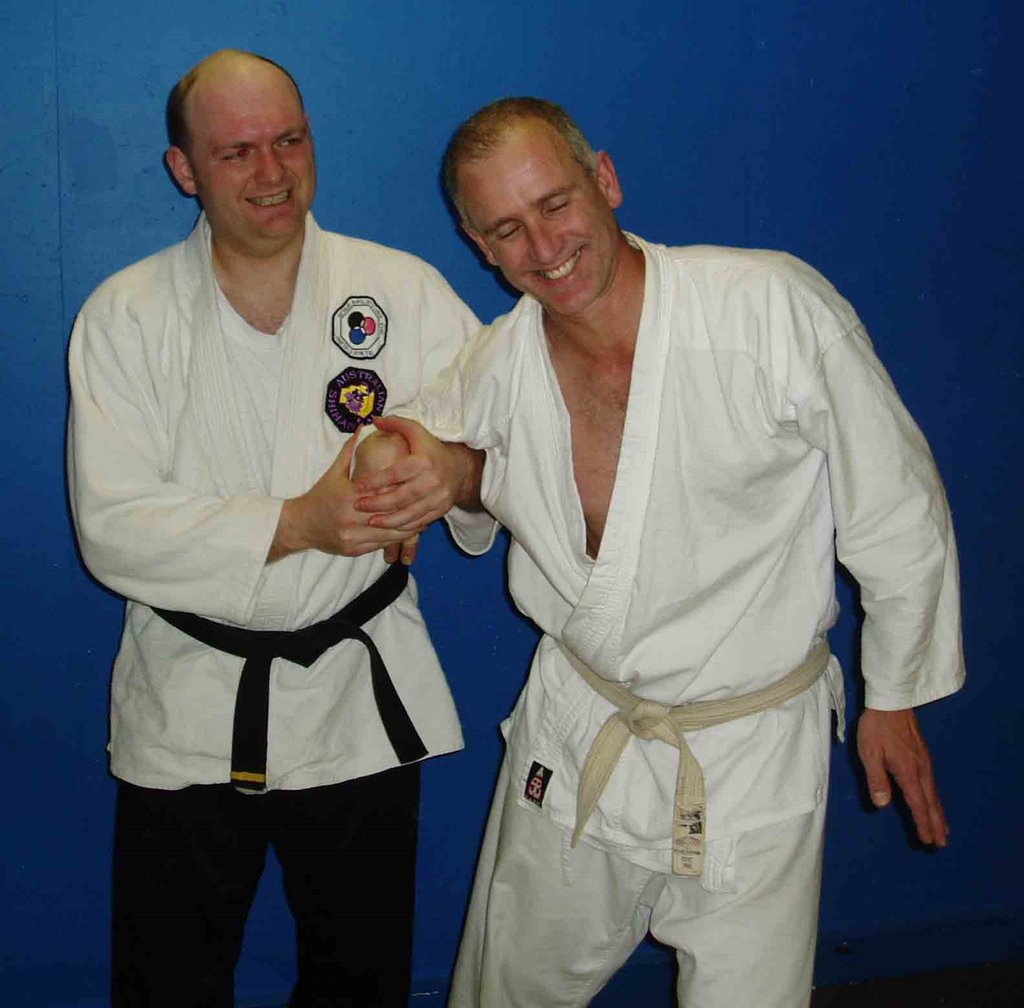
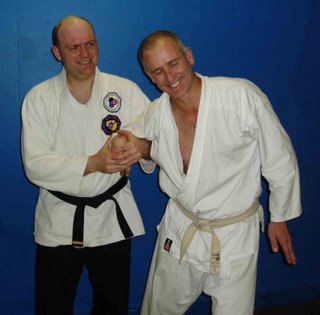
A: It's an arresting technique from Jiu-Jitsu, a Japanese martial art.

Q: Who's performing the technique?
A: That's me, Sensei Dan, in the black belt, applying the technique. David, one of my students, is receiving the technique.

Q: Does it have a name?
A: It's called the Nurse's Grip Gooseneck. The Gooseneck refers to the bend in David's wrist. The Nurse's Grip refers to the means of entering the technique (not shown).

Q: Does it hurt?
A: Yes. In the picture I have stretched the wrist to the threshold of pain. If I were to continue further I would begin to damage the soft tissues, and eventually dislocate the joint.

Q [Nervously]: Is it safe?
A: Yes, under the supervision of a qualified instructor.

Q: But how do you practice it safely?
A: The technique is applied slowly (and smoothly), and when the receiver starts to feels the stretch he (or she) taps twice to indicate submission, and the applier releases the grip.

Q: If I were to use this technique in self-defence, would I have to cause serious damage for it to be effective?
A: Not necessarily. Self-defence is situation dependant. Once you are skilful enough you will be able to feel your attacker's body start to crumple from the pain and -- for example -- choose to escort him to a police station. Techniques such as this have built-in flexibility, allowing the practitioner discretion in level of escalation.

Q: Will it work in a fight?
A: Maybe. First, you need to know the technique inside-out. Second, an appropriate situation needs to arise in combat, and needs to be recognised and seized. Third, your assailant must fail to counter it. Fourth, if your assailant succeeds in countering, you need to flow into another technique.

Q: That sounds complicated.
A: Well, you build up to it over time. It's why a high standard of instruction and regular training are needed to learn sophisticated martial arts. You start by learning isolated techniques, in a standard format, and later practice them against specific attacks. Free-form practice comes later still.

Q: Are there many techniques like this?
A: In our syllabus there are around 80 standard restraint and control techniques, not counting variations. The Nurse's Grip Gooseneck is the second taught in the standard sequence.
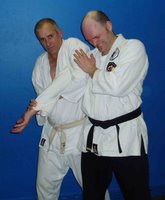
Q: Can I see more?
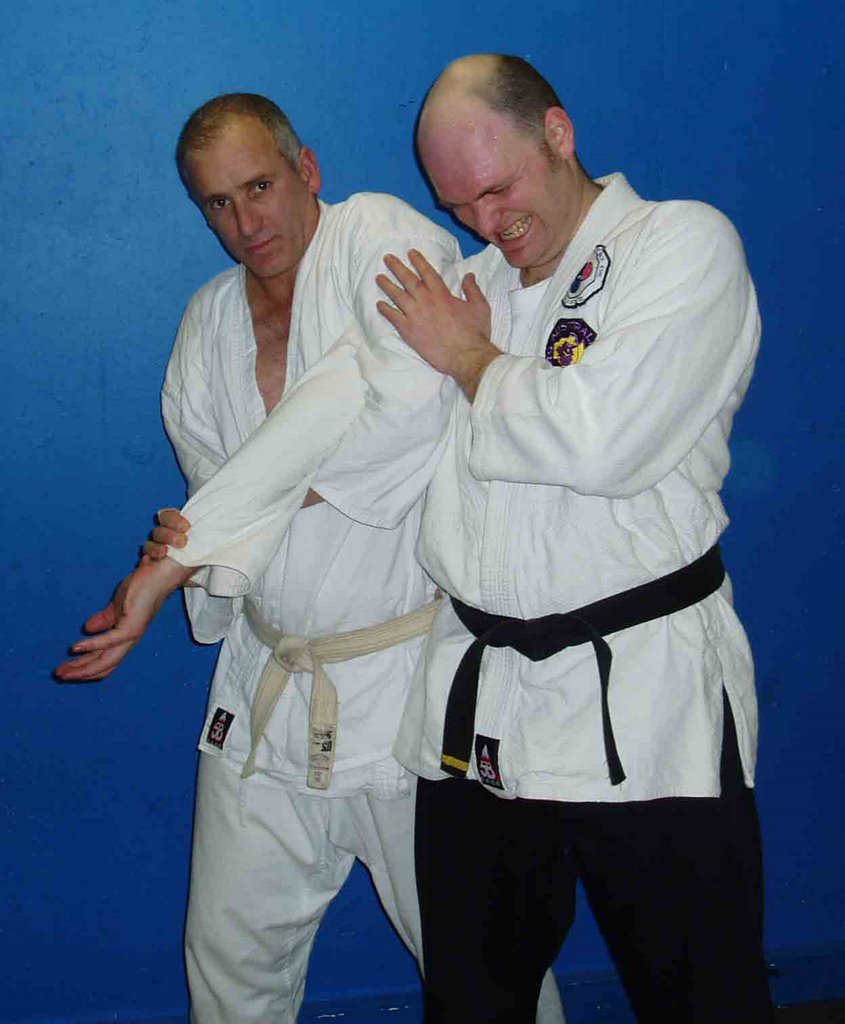
A: Sure. Here's another arresting technique, the Come-along armbar.

Q: So you allow your students to apply these techniques to you?
A: Yes.

Q: Why?
A: It allows me to feel for imperfections in their technique, and for them to feel how to receive a technique. Mainly I teach in a small group setting and students practice in pairs.

Q: Sounds great, but how do I find out more?
A: Check out the links down the side of this web-page and read some of the other posts. If you have a specific question, please leave a comment, and I'll get back to you.