Showing posts with label joint locks. Show all posts

Saturday, October 17, 2009

Go on: Put me in a lock!

In jiu-jitsu we learn a lot of joint lots, mainly as part of our restraint and control syllabus.

To apply them for real you need to be more skilful than your opponent because people will try to naturally try to escape, typically by either using muscular resistance or trying to twist themselves out. Part of the art is first breaking your partner's balance, so that (s)he loses the ability to effectively resist, as well as adapting to whatever response they (s)he manages to muster.

But what happens if your opponent is simply much, much better than you? Check it out:


Although the attacker is allowed to start to apply locks, at no stage does he control the defender's balance (or center). Quite the reverse!

Friday, September 11, 2009

What on earth is that technique?

I'll start with an easy one:
What on earth is the technique you’re trying to do in that picture? If it’s ude-giri your hand is too high up his arm (pressing down on his shoulder or the upper part of his arm isn’t going to do much), for waki-gatame you’re standing too upright and it can’t be just kote-mawashi since it’s impossible to put enough pressure on the wrist in that position. Besides that kiba-dachi, while traditional, is not a great stance for that position since he can just plant his knee into yours and you’ll collapse, losing the hold. -- Zara
This is reference to a now retired side-bar image, actually taken from a past post and reproduced below:
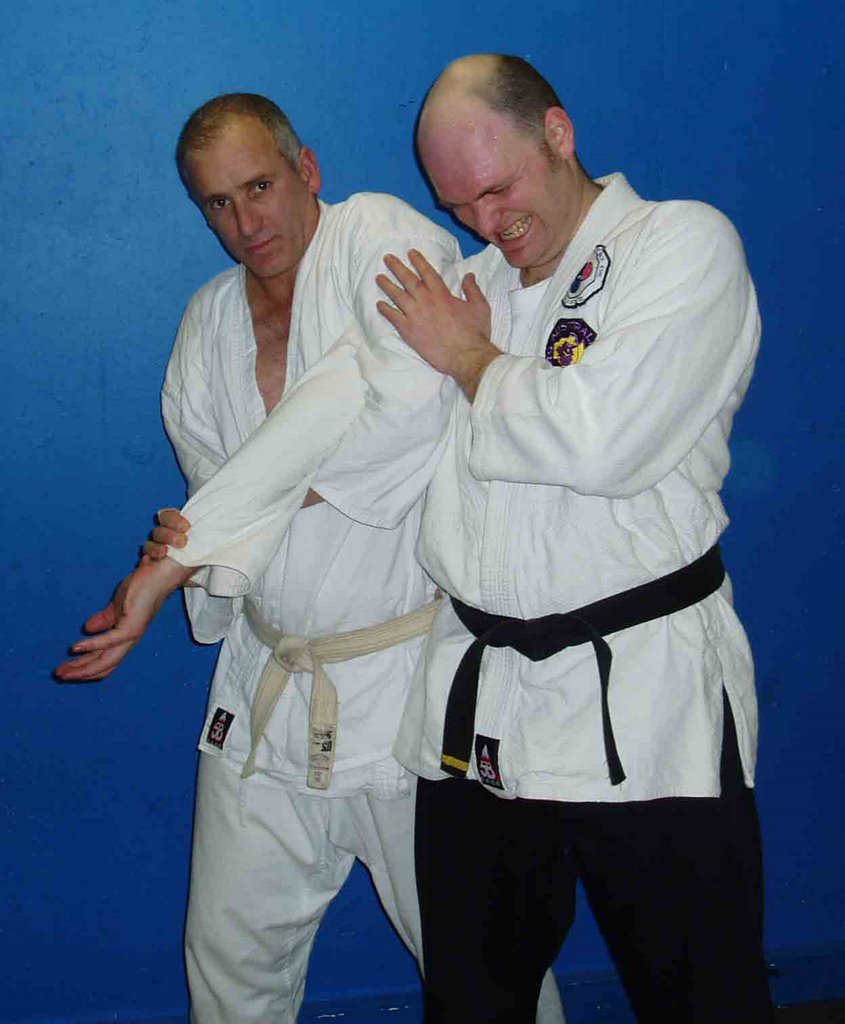
In Jiu-Jitsu formal stances are typically used transitionally, and are learned in the context of actual application. For example, in this photo I am applying a reverse-armbar -- a restraint and control technique -- from a horse-riding stance:


A reverse armbar

From here I could take Adam down to the ground or move into a more mobile lock to better escort him to the local police station. Either way I would not need to stay in this position for very long.
Of the techniques listed, I'd say it's closest to waki-gatame:


Standing waki-gatame

Think of it as a variation.

The neat thing about the reverse-armbar is that there are lots of ways to make it work. You can lock the shoulder, elbow, and wrist. If you have difficulty with one joint -- typically resistance or flexibility -- you can switch emphasis to another.

In this case Adam has a fairly flexible elbow -- note the hyper-extension -- so I'm using the wrist and using my ulna bone to painfully slice into his upper arm (an alternative to torquing the shoulder - probably more jiu-jitsu than judo!).

As to the risk of his planting his knee: I don't think so! Sure it's a posed shot, but given that I've got the lock and his balance, as he moves I either inflict more pain, stopping the movement, or flow with it into something else.

Wednesday, September 09, 2009

Arresting techniques

Zara left a detailed comment on one of my articles from 2008 -- Some notes on come-along techniques -- raising some interesting points.
Very interesting article, come-alongs or taiho-waza (arresting-techniques) are fascinating to study but often an area that is poorly understood and consequently just glanced over. Probably because it's inherently dangerous to attempt to control a standing, struggling opponent (always risky in terms of escape and counterattack) and very technical in nature. -- Zara
Thank-you. Like most sophisticated areas in martial arts these techniques need expert instruction and significant, regular practice to achieve competence; and more instruction and practice to make 'em really good.
If techniques and body-mechanics aren't perfectly understood and executed the adequate pain-level will not always be maintained: either you'll injure him or he'll just slip out and since most people don't take kindly to such treatment you'll be in for one hell of a fight.
There's certainly a need for sensitivity in training these techniques and that comes with cooperative practice over a long period. You need to be able to feel that the lock is on, and practicing very slowly is both safe for training and a good way to acquire the necessary sensitivity.

I once trained with some Olympic judoka who were all very strong and had effective if muscular throws, but their locks were not good at all. They were used to competitive practice, and seemed afraid of having their arms snapped; not trust, and probably with good reason! Consequently they had no feel for locking.

Uke's balance must also be broken. Along with pain compliance this reduces the strength that can be brought into play to resist the technique. For example, I have some very flexible students who I just can't make certain locks work on, but in attempting to apply the techniqueI invariably break their balance to a huge extent. In a self-defence situation you need to be able to feel that a lock isn't working and aim to make a clean transition into a different lock or throw. This ability requires lots of practice to acquire!

The issue of making these locks work in a self-defence situation is interesting. In the system I do we teach model entries, plus effective transitions out of escapes from standard attacks (usually grabs, chokes, or other holds) into locks and throws. These also need to be practiced until they become second nature.
I'm training for my first dan in ju-jutsu, part of the requirements are two come-alongs while uke is standing, two when he's lying flat on his belly and two on his back (forcing him to stand up). I do think I have some notion of which techniques would be suitable for these tasks but I would appreciate it if you would write a follow-up post to this one delving a bit deeper and going over some appropriate techniques (preferably with photo's).
Interesting requirements. Rather than do your homework for you ;-), I suggest that you take the locks you have in mind and carefully experiment with them with a fellow senior student. Managing the movement from floor to standing while safely maintaining control is the name of the game. Telling your uke what to do is also helpful, "Roll onto your side! Get-up!", but you must allow them, even help them to do so.

Please let us know how you get on with your explorations, and what you learn. Your own instructor(s) should be your first and best source for detailed, hands-on guidance.

Good luck!

Thursday, May 07, 2009

Don't just crank it on!

When someone actively resists your attempt to apply a joint-lock, most people fall into the trap of applying more and more force.  Besides being dangerous -- if it eventually works you may well hyperextend the joint -- this approach contradicts the "minimum effort" part of this month's theme.  Pretty soon you find yourself exerting maximum effort to minimum effect.

Three better alternatives:
  1. Distract: A light strike or -- even the threat of a strike -- to a vulnerable will take your partner's focus away from their resistance for a moment, and that should be long enough to apply the lock.  [Other distractions: pinches, kiais, etc. can also do the same job.]
  2. Change the focus of the lock: Most locks either use or have the potential for a two-way action.  Usually the resistance will arise at the point where you are applying most of the force.  Switch your emphasis to another point of contact (and maybe back again).
  3. Flow into a different technique: Make use of the resistive force supplied by your partner to power the transition.  Now the resistance is working for you.
All of these options emphasize skill, sensitivity and knowledge over brute strength.

As the Borg of Star Trek say: "Strength is irrelevant. Resistance is futile.  We wish to improve ourselves."  

And Bjorn Borg (former tennis great): "You have to find it. No one else can find it for you".

Thursday, September 07, 2006

Jiu-Jitsu in Pictures: Your Questions Answered

Q: What is it?
A: It's an arresting technique from Jiu-Jitsu, a Japanese martial art.

Q: Who's performing the technique?
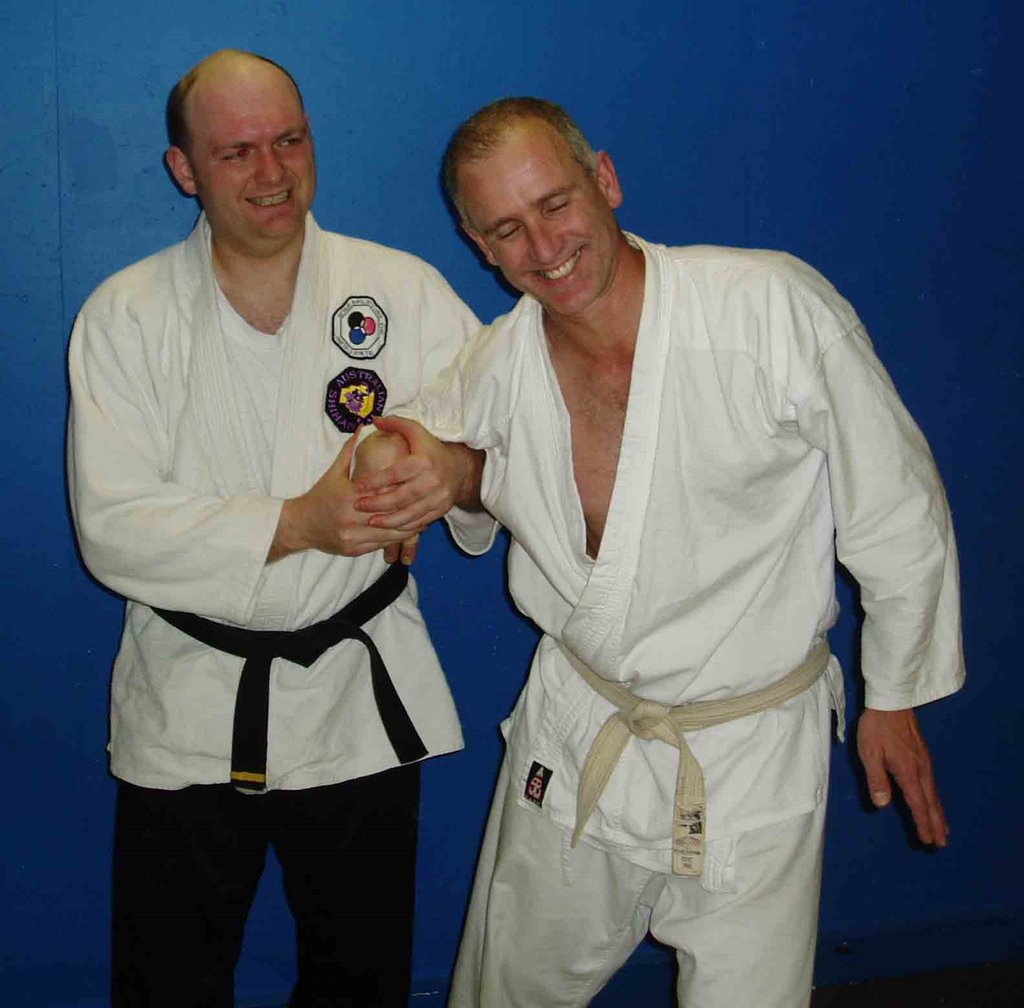
A: That's me, Sensei Dan, in the black belt, applying the technique. David, one of my students, is receiving the technique.

Q: Does it have a name?
A: It's called the Nurse's Grip Gooseneck. The Gooseneck refers to the bend in David's wrist. The Nurse's Grip refers to the means of entering the technique (not shown).

Q: Does it hurt?
A: Yes. In the picture I have stretched the wrist to the threshold of pain. If I were to continue further I would begin to damage the soft tissues, and eventually dislocate the joint.

Q [Nervously]: Is it safe?
A: Yes, under the supervision of a qualified instructor.

Q: But how do you practice it safely?
A: The technique is applied slowly (and smoothly), and when the receiver starts to feels the stretch he (or she) taps twice to indicate submission, and the applier releases the grip.

Q: If I were to use this technique in self-defence, would I have to cause serious damage for it to be effective?
A: Not necessarily. Self-defence is situation dependant. Once you are skilful enough you will be able to feel your attacker's body start to crumple from the pain and -- for example -- choose to escort him to a police station. Techniques such as this have built-in flexibility, allowing the practitioner discretion in level of escalation.

Q: Will it work in a fight?
A: Maybe. First, you need to know the technique inside-out. Second, an appropriate situation needs to arise in combat, and needs to be recognised and seized. Third, your assailant must fail to counter it. Fourth, if your assailant succeeds in countering, you need to flow into another technique.

Q: That sounds complicated.
A: Well, you build up to it over time. It's why a high standard of instruction and regular training are needed to learn sophisticated martial arts. You start by learning isolated techniques, in a standard format, and later practice them against specific attacks. Free-form practice comes later still.

Q: Are there many techniques like this?
A: In our syllabus there are around 80 standard restraint and control techniques, not counting variations. The Nurse's Grip Gooseneck is the second taught in the standard sequence.
Q: Can I see more?
A: Sure. Here's another arresting technique, the Come-along armbar.

Q: So you allow your students to apply these techniques to you?
A: Yes.

Q: Why?
A: It allows me to feel for imperfections in their technique, and for them to feel how to receive a technique. Mainly I teach in a small group setting and students practice in pairs.

Q: Sounds great, but how do I find out more?
A: Check out the links down the side of this web-page and read some of the other posts. If you have a specific question, please leave a comment, and I'll get back to you.