Saturday, October 23, 2010

Full mat!

The mat's looking pretty full nowadays. With a large class it's starting to get cramped during warm-ups:

Warming up with some breakfalls
And it's really full when everyone stretches out:

The class at rest

Sunday, October 10, 2010

Throw or takedown?

John Coles is investigating the difference between throws and takedowns in the martial arts for his forthcoming book, and has written a couple of blog posts on the subject.  John points to some discussion of the various takes on the difference this thread from the Martial Arts Planet forum.

An empirical exploration that anyone (with a bit of experience) can do is go through their style's syllabus and pull out the techniques explicitly labelled as throws and those labelled as takedowns and look for any differences of principle.

That's what I intend to do!

Saturday, October 09, 2010

Getting Things Done

I haven't been blogging much in the last couple of months, and with good reason: a new job, complete with learning curve and travel, and consequently a paring back on other activities.   A good friend told me that getting settled in to a new job typically takes three to six months, which sounds about right.

Anyhoo, as part of my drive to get more organized in my new gig (and generally), I finally picked up a copy of Getting Things Done: The Art of Stress-Free Productivity by David Allen -- perplexingly re-titled "How to Get Things Done" for the Australian edition -- something of a "sacred text" for the geeky Lifehacking movement.

Here's an article from Wired magazine Getting Things Done Guru David Allen and His Cult of Hyperefficiency that delves into the somewhat colorful background of the author.

A synopsis of the approach, given at Google (46 minutes):

What I hadn't realised previously, and what the video and the book make quite clear is that GTD is in many ways an application of a few martial arts principles to the very modern problem of having too much on one's plate.  The author claims past experience as a karate instructor, and builds much of his approach around working towards an ideal state of having a "mind like water".  Rationalism plus martial arts: what's not to like?

For those not ready for the somewhat daunting transformation that an approach like GTD entails, there is the highly amusing structured procrastination, which I recommend reading, but would counsel against adopting!

Wushu vs Chen Village

This first clip is of a wushu competitor performing a (winning) Chen-style-taijiquan-inspired routine:


And this is Chen Bing of Chen village doing a section of  the actual Chen-style taijiquan cannon fist routine:


Quite a difference!

Saturday, August 28, 2010

Left-handed training

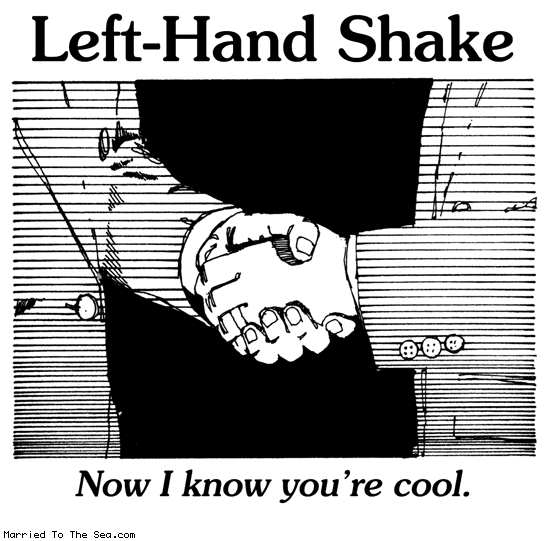
Traditionally, jiu-jitsu is performed right-handed: "there are no left-handed swordsmen in Japan".  The jiu-jitsu syllabus is large enough that for self-defence purposes ambidextrosity is not required for many techniques: need the left-handed version of a technique?  Use something else instead.

marriedtothesea.com

On the other hand(!) judo techniques are often practiced on the non-preferred side -- hidari in Japanese -- thereby developing the body evenly on both sides.

For me, one of the best reasons to practice left-handed is to increase one's focus on what you're doing.  A reasonably well-grooved technique suddenly becomes challenging again.  I find myself changing from side-to-side, engaging in self-observation and self-teaching as I work to transfer the technique to the other side.  And the best thing ... the original migi side inevitably benefits too.

Other reasons to practice left-handed:
  • Injury: sometimes its unsafe to work on the regular side
  • Rehab: I have been working on one of my Chinese boxing weapon sets left-handed to try to stretch and strengthen a shoulder that appears to have sustained a (mild) injury
  • Teaching ploy: One of my students, who had previously been programmed to do a very different (Olympic judo) version of a throw, is learning our version in hidari first, as a stepping stone
In sum, I recommend occasionally training on the non-preferred side, as opposed to: never (traditional), 50-50, or mainly non-preferred (a competition-oriented strategy).